A sleeve is not a bunch of cool tattoos piled onto one arm. It is a full-body-art project with flow, breathing room, and a point of view. Good tattoo sleeve planning keeps you from ending up with a crowded collection of unrelated pieces that fight each other every time you look in the mirror.
That does not mean every inch needs to be mapped before your first appointment. Some of the best sleeves grow over years. But you do need a direction, an artist whose work fits that direction, and enough of a plan to make the next tattoo feel intentional instead of random.
Start Tattoo Sleeve Planning With the Big Picture
First, decide what you want your arm to say from a few feet away. Not every tiny detail – the overall energy. Maybe it is dark botanical work with skulls and ravens. Maybe it is bright neo-traditional flash with a weird, joyful circus vibe. Maybe it is fine-line black and gray imagery built around family, place, and memory.
Think about the sleeve in terms of a visual world. Themes help, but they do not have to be literal. A sleeve about resilience can include storm clouds, a busted chain, wildflowers, a favorite lyric, and an animal that means something to you. The connection can be emotional rather than obvious.
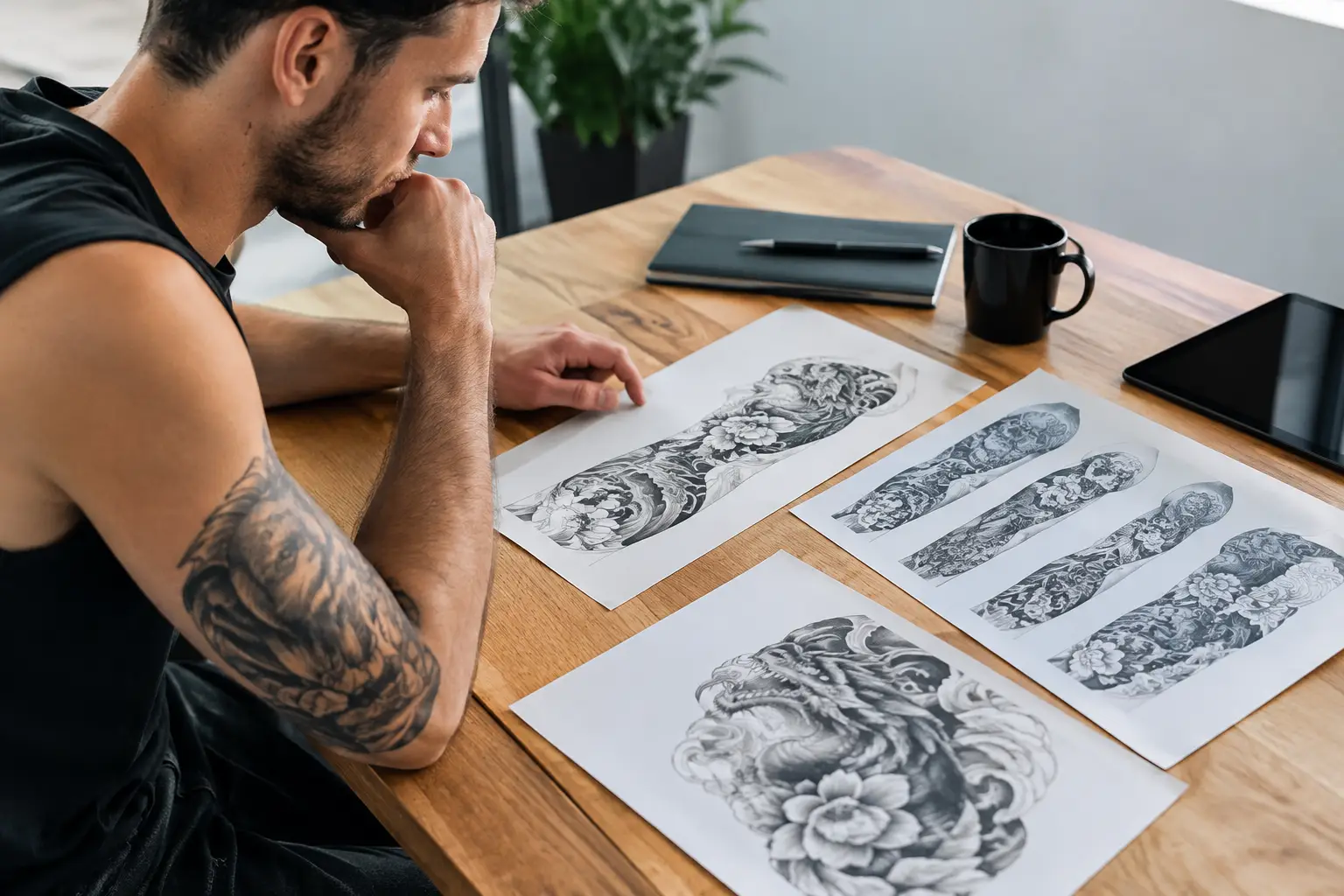
Start by collecting references that show mood, composition, color palette, and texture. Include tattoos you love, but also album art, old photos, fabric patterns, movie stills, plants, architecture, or anything else that carries the feeling. Your artist does not need ten screenshots of the same tattoo from Pinterest. They need to understand what you are drawn to and why.
Be honest about the pieces you already have, too. A great sleeve plan works with the art on your body now. Sometimes that means building around an existing tattoo. Sometimes it means reworking it, adding a background, or accepting that it will become part of a louder, more layered arm. Cover-ups and major reworks may require different decisions about size, contrast, and color.
Choose Your Sleeve Shape Before the Details
“Sleeve” can mean a lot of things. A full sleeve runs from shoulder to wrist. A half sleeve generally covers shoulder to elbow or elbow to wrist. A three-quarter sleeve lands somewhere in between. Each option has different practical and visual advantages.
A full sleeve gives an artist room to create transitions, contrast, and a real sense of movement. It also asks for a bigger commitment in time, money, healing, and visibility. A half sleeve can feel complete on its own while leaving space for future work. Starting with an upper arm piece is common because it is easier to conceal, but a forearm-focused project makes a stronger day-to-day statement.
Placement matters inside the sleeve, not just at its edges. The outer arm is high visibility and often gets the hero image: a panther, portrait, dragon, pinup, dagger, or large floral arrangement. The inner bicep and inner forearm are more intimate spaces and can suit meaningful text or detailed imagery. The elbow needs special thought because the skin moves constantly and wears differently. A strong design can use that movement – webs, flowers, eyes, spirals, geometric forms, and radiating imagery often work well there.
Your artist will also consider how the design reads when your arm is relaxed, bent, or hanging at your side. A flat drawing is only the start. Your body is part of the composition.
Pick an Artist for the Style, Not Just the Appointment Slot
Different strokes for different folks, and different artists for different sleeves. A killer traditional artist may not be the best fit for a delicate realism project. An artist known for fine-line florals may not be the person you want for a saturated Japanese-inspired dragon sleeve.
Look closely at healed work, not only fresh tattoos under perfect lighting. Check line quality, saturation, black shading, composition, and whether the artist can make multiple tattoos feel connected across a moving arm. If you already have a piece you want incorporated, look for someone experienced in reworks or integration work.
Then bring your ideas to a consultation and let the artist do their job. Custom tattooing is collaboration, not a vending machine. You should be clear about your must-haves, your no-go subjects, your budget range, and whether you want color or black and gray. But give your artist room to solve the visual problem. Their job is to turn references into original art that fits your anatomy and heals well.
At Apocalypse Girl Tattoo, that artist-fit conversation matters. The goal is not to force your idea into somebody else’s style. It is to pair your concept with the right creative brain, then build something that feels like it was always meant to live on your arm.
Make the Connections Feel Intentional
The negative space between tattoos is where sleeves either breathe or become a traffic jam. You have several ways to connect separate images: background shading, smoke, clouds, leaves, ornamental linework, stars, dots, webbing, water, flames, or open skin used with purpose.
There is a trade-off. Heavy background can unify unrelated pieces fast, especially in black and gray work, but it can also make a sleeve feel darker and reduce the punch of smaller tattoos. Leaving more skin visible creates a patchwork feel and gives each piece room, but requires sharper placement decisions. Neither approach is more legitimate. It depends on the look you want.
Try not to fill every small gap just because bare skin feels unfinished in the moment. A good artist may tell you to wait. That is not indecision. It is composition. Some open space gives the eye a place to rest and leaves room for future ideas that actually deserve a spot.
Plan for Time, Budget, and Healing
A sleeve is usually a series of sessions, not one wild Saturday. The number depends on style, coverage, detail, color saturation, existing tattoos, your skin, and how much time you can comfortably sit. A bold traditional sleeve may move differently than a high-detail realism project. Fine-line work can look deceptively simple while demanding patient, precise application.
Build a realistic budget before you commit. Quality custom work costs more than a rushed shortcut, and the arm is a lot of valuable real estate. You do not have to finish the sleeve all at once, but you should avoid starting a project you cannot continue for years if the design relies heavily on connected background work.
Healing deserves the same respect as the design. Book around beach trips, intense sun exposure, contact sports, and any job demands that make fresh tattoo care difficult. Wear loose, clean clothing, follow your artist’s aftercare instructions, and do not pick, scratch, or soak the tattoo. Your healed result is part artist skill, part client care.
If you are working session by session, ask how long to wait between appointments. Your artist will base that on how the previous tattoo has healed and where the next work will go. Pushing too fast can make the process rougher than it needs to be.
A Quick Reality Check Before You Commit
Before the stencil goes on, make sure you can answer these questions without guessing:
- What style and overall mood am I building toward?
- Which parts of the arm do I want visible, private, or left open?
- Do I want a fully connected sleeve or a curated patchwork look?
- Can I commit to the cost, healing time, and multiple sessions?
- Have I chosen this artist because their portfolio matches the project?
You do not need a perfect master plan. You need a clear enough direction that every new piece has somewhere to go.
A sleeve should feel like your story, not somebody else’s mood board. Bring the memories, references, strange obsessions, and big ideas. Bring them to an artist you trust, take the time to build it right, and let the arm become art worth looking at for the rest of your life.